Amish Sethi
PhD Student at Harvard University
Hi, I am Amish. I am a PhD student at Harvard University, advised by Heng Yang and Yilun Du and supported by the Kempner Institute Graduate Fellowship and the NSF Graduate Research Fellowship. Before Harvard, I studied at the University of Pennsylvania, where I received a Bachelor's in Computer Science and a Master's in Computer and Information Science.
My research builds toward reliable embodied AI. I work on foundation models that connect video, language, and robot action, on scalable neurosymbolic learning, and on understanding and adapting large generative models. I enjoy building efficient and interpretable systems that stay robust when they leave the lab and meet the open world.
This past summer I was a Research Lead at AfterQuery, where I worked on the next large benchmark for embodied agents and on scaling robotics data collection well beyond teleoperation, including UMI-Live, a more capable take on the Universal Manipulation Interface. I have been lucky to be guided by Mayur Naik and Dinesh Jayaraman at Penn and by Zhuang Liu at Princeton, and I am grateful to the PhD students who mentored me along the way, including Jiani Huang, Neelay Velingker, Zhiqiu Xu, Aaditya Naik, Boya Zeng, Wenhao Chai, Aurora Qian, Junyao Shi, and Chris Watson.

amishsethi [at] g.harvard.edu
News
| Sep 2026 | Started my PhD at Harvard with Heng Yang and Yilun Du. |
| Sep 2026 | Our paper Do Diffusion Models Learn to Generalize Basic Visual Skills was accepted to NeurIPS 2026. |
| Jun 2026 | Started as a Research Lead at AfterQuery for the summer, building a new benchmark for embodied agents and scaling robot data collection beyond teleoperation. |
| May 2026 | Graduated from Penn with a BSE in Computer Science and an MSE in Computer and Information Science, and received the John Grist Brainerd Award from Penn Engineering. |
| Apr 2026 | Awarded the NSF Graduate Research Fellowship and named a Kempner Institute Graduate Fellow. I will begin my PhD at Harvard this fall with Heng Yang and Yilun Du. |
| Dec 2025 | Received an Honorable Mention for the CRA Outstanding Undergraduate Researcher Award. |
| Dec 2025 | Google highlighted our ESCA work on the Google Open Source Blog, and Penn Engineering featured it on the front page of their site and socials. |
| Sep 2025 | Our paper ESCA was accepted to NeurIPS 2025 as a Spotlight, placing it in the top 3 percent of submissions. |
| May 2025 | Our paper Dolphin was accepted to ICML 2025. |
Selected Publications
A few highlights are below. For the full list, see my publications page or Google Scholar. Authors marked with an asterisk contributed equally, and a dagger marks equal advising.
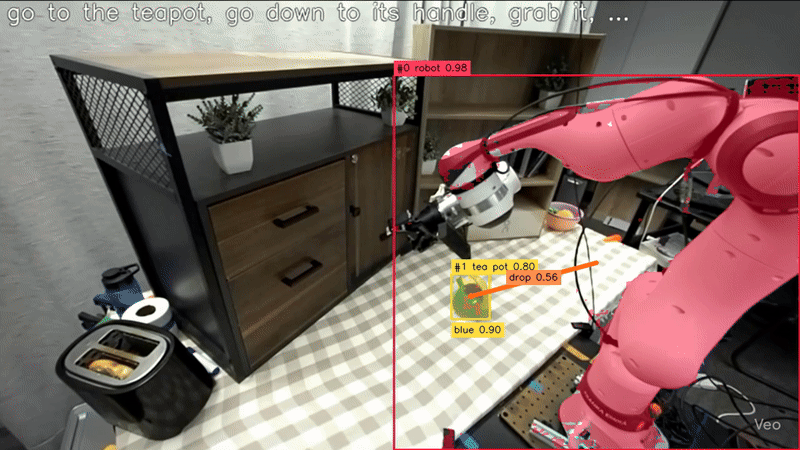
CoRL 2026 UMI Arena Workshop · senior thesis
RA-VLA retrieves a similar demonstration from a large robot dataset, warps it to the current scene with a multimodal language model, and overlays it as guidance for a fine-tuned policy, lifting task success with no new demonstrations collected.
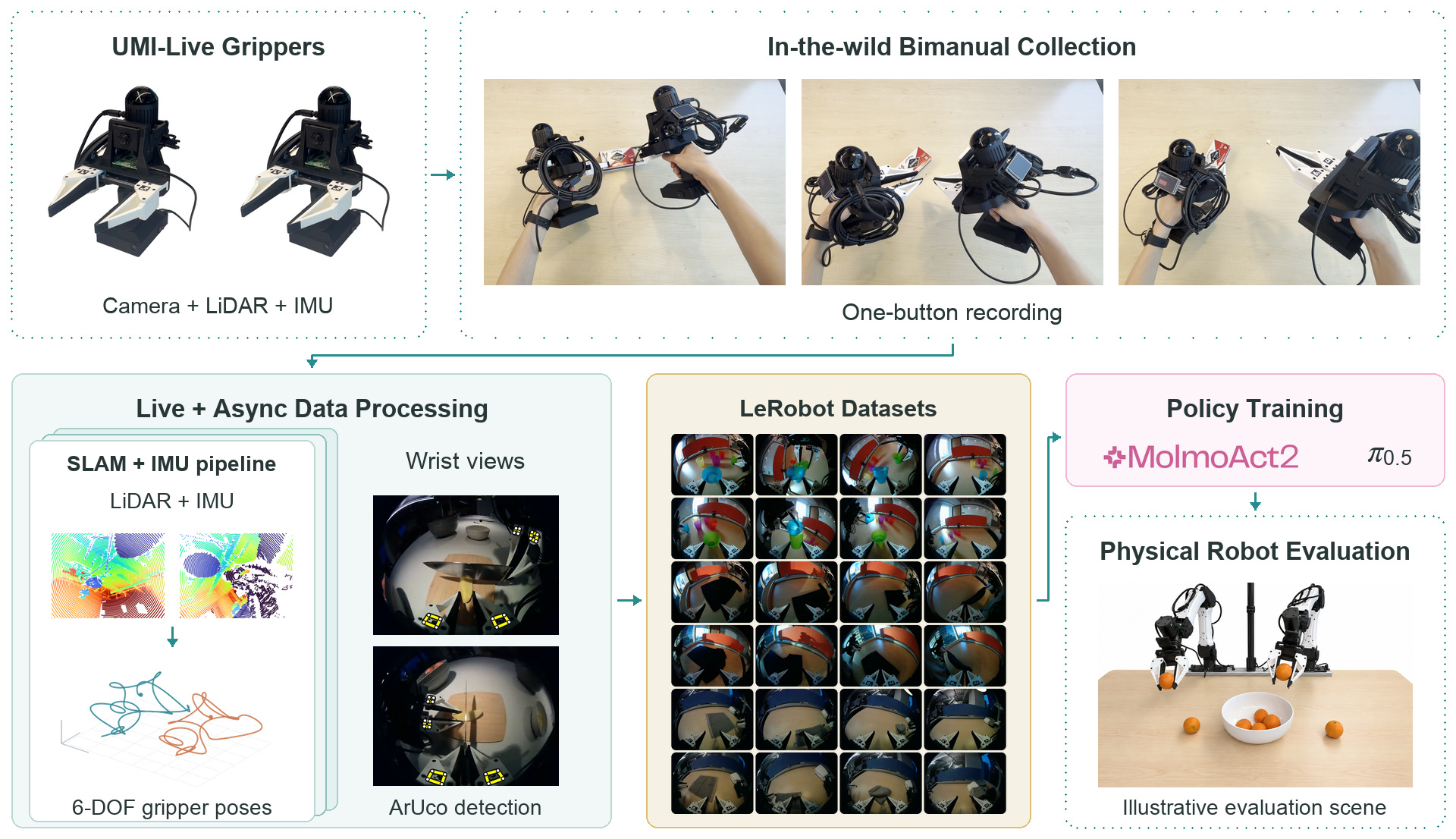
CoRL 2026 UMI Arena Workshop
UMI-Live is a handheld bimanual system for collecting robot demonstrations in the wild. Custom grippers combine a camera, LiDAR, inertial sensing, and onboard compute, and each recording is reconstructed and converted into a LeRobot dataset for policy training.

NeurIPS 2025 · Spotlight, top 3%
ESCA turns video into spatio-temporal scene graphs that give vision language models explicit spatial context, cutting perception errors from 69 percent to 30 percent on EmbodiedBench without retraining the underlying models.
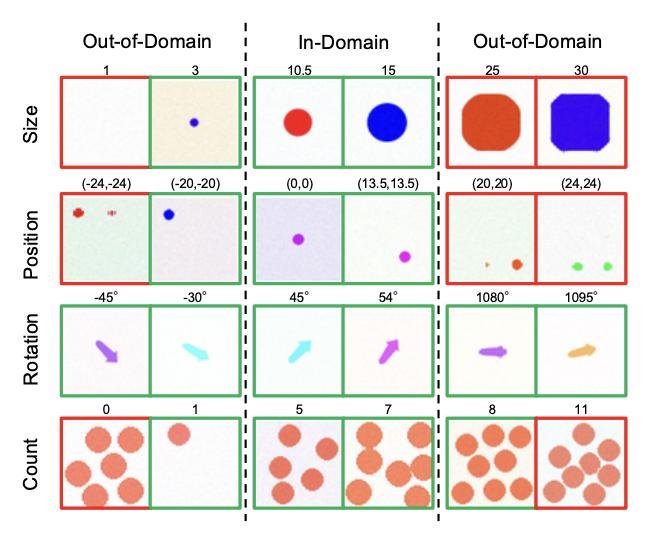
A controlled study trains diffusion models on synthetic data that isolates size, position, and rotation, showing they interpolate well within the training distribution yet fail to extrapolate beyond it.
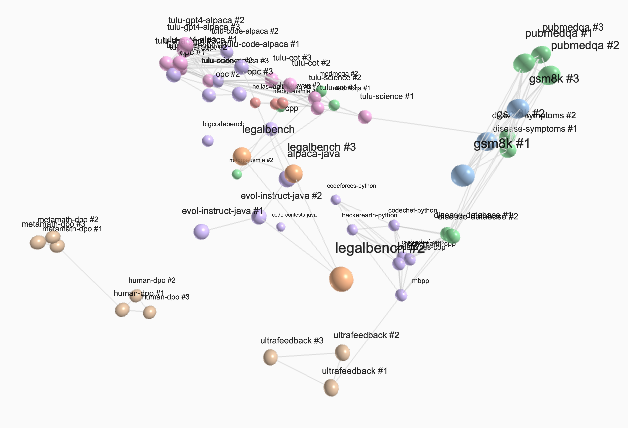
Under review at ICLR 2027 · NeurIPS 2025 ER Workshop
Delta Activations represent a finetuned model by how its internal activations shift from a base model, which clusters models cleanly by domain and enables task based retrieval across the more than 700 models we released on Hugging Face.

Dolphin combines symbolic reasoning with neural computation through a CPU and GPU hybrid execution strategy. By vectorizing probabilistic computations on the GPU it reaches up to 62 times faster convergence than baselines across 13 benchmarks that span text, image, and video.
Honors & Awards
The oldest and one of the most prestigious graduate fellowships in the United States. It provides three years of funding to outstanding students pursuing research based degrees in science and engineering, drawn from a national pool of more than ten thousand applicants each year.
The Kempner Institute studies the foundations of natural and artificial intelligence. Its graduate fellowship supports a small cohort of Harvard PhD students each year with multi year funding, mentorship, and access to one of the largest academic AI compute clusters in the world.
Given each year to the graduating senior who, in the judgment of the faculty and based on their entire undergraduate record, best exemplifies the character, scholarship, professional attitude, and broad interests of the modern engineer. The award honors John Grist Brainerd, who led the ENIAC project at Penn.
A North America wide award that recognizes undergraduates who show outstanding research potential in computing. I was also one of Penn's four nominees for the year. See the award page.
NeurIPS 2025 Spotlight for ESCA (top 3 percent), First Place at the International Public Policy Forum (2022), National Merit Scholar, and ISEF Finalist in genetics research (2021).
Experience
Leading research on the next large benchmark for embodied agents and on scaling robotics data collection beyond teleoperation, including a more capable handheld interface for in the wild robot demonstrations.
Built FIIGNET, a generative pipeline that synthesizes images of diseased fish for aquaponics early detection, improving detection accuracy by 17 percent across synthetic and real datasets.
Developed a Mask R-CNN model that detects and classifies traffic signs from video with 90 percent accuracy. The system was deployed by the Pennsylvania state government to maintain an inventory of road assets.
Teaching & Service
In Fall 2024 I served as Head Teaching Assistant for CIS 7000, Large Language Models, Penn's first dedicated course on LLMs with more than 120 students. I planned curriculum, designed assignments, held office hours, and lectured on efficient finetuning, adaptation, and evaluation.
In Summer 2024 I mentored five undergraduates through the Penn Undergraduate Research Mentoring Program on the CLAM project. I also authored a successful proposal for the Grant for Faculty Mentoring Undergraduate Research, which awarded 8,000 dollars to fund research on neurosymbolic AI.
I have served as a reviewer for the ICML 2024 ES-FoMo Workshop, AAAI 2026, and ICLR 2026.